Food & tea · A GUIDE FOR YOUR JAPAN VISIT
Six Chinese tea categories—and how to enjoy a tea house in Japan
From green tea to oolong and dark tea, start with processing, flavour and a few practical questions.
Written and edited by the TOYO BIYORI editorial team
Japanese publication: 2026.10.18 · English adaptation: 29 October 2026
Six categories, one tea plant
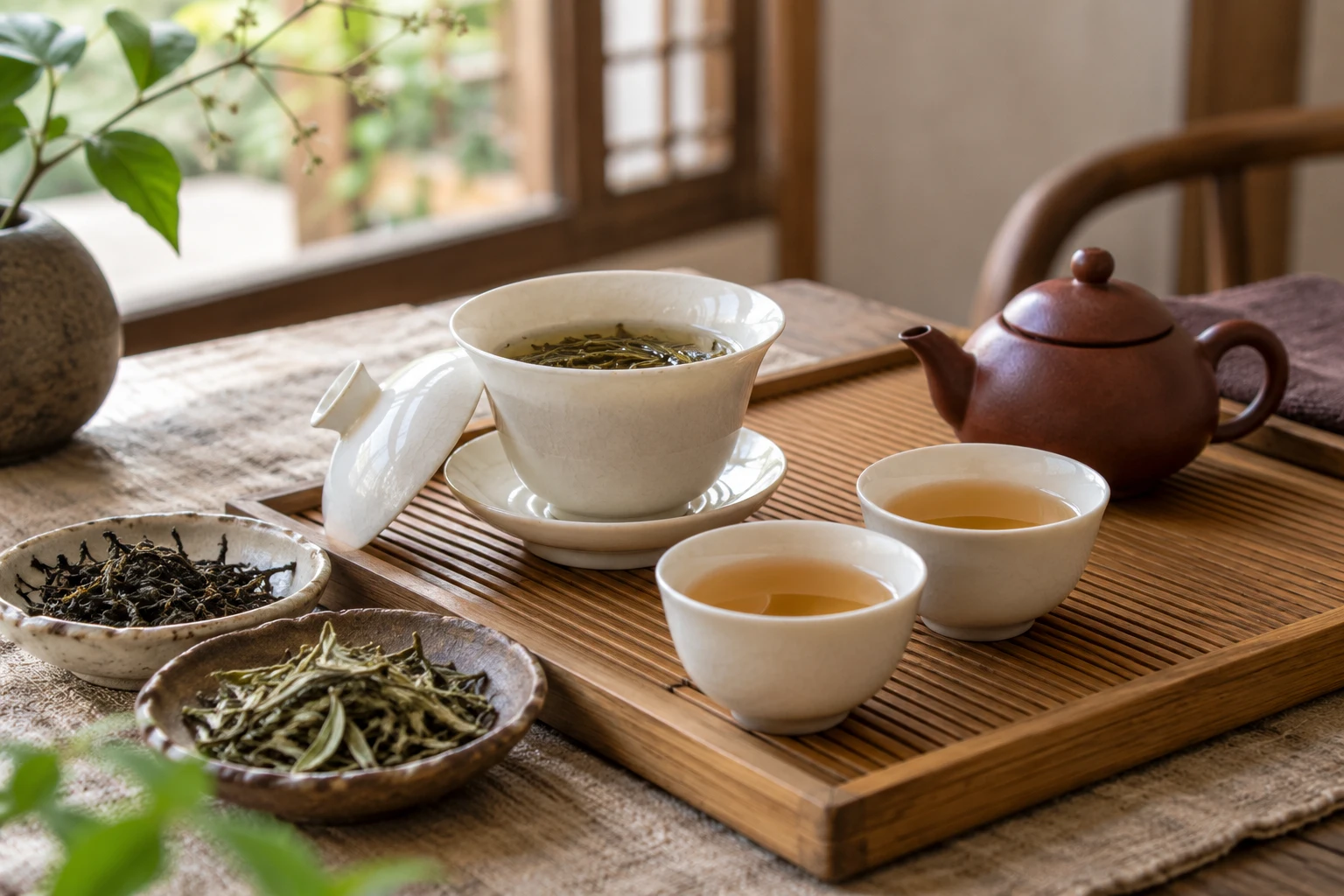
Chinese tea is commonly grouped by processing into green, white, yellow, oolong, black and dark tea. Oxidation involving the leaf’s own enzymes is different from fermentation involving microorganisms. English tea names can be confusing: Chinese hongcha, literally ‘red tea’, is what English usually calls black tea; heicha is dark tea.
Green tea, such as Longjing, is processed to limit oxidation and often tastes fresh and light. White teas such as Bai Mudan and Baihao Yinzhen are lightly processed. Yellow tea includes a warm, moist yellowing stage; Junshan Yinzhen is one example.
Oolong is partially oxidised, with a wide range of floral, fruity and roasted characters. Examples include Tieguanyin, Dongfang Meiren and Dong Ding. Black tea such as Keemun is extensively oxidised. Dark tea undergoes microbial fermentation; ripe pu-erh and Liubao are examples.
Traditional ideas are a cultural lens
Traditional Chinese dietary practice describes some teas as ‘cooling’ and others as ‘warming’. Green tea is often placed towards the cooling side, while black and dark teas are commonly described as warming.
These are traditional categories, not proof that a tea will produce a particular medical effect or change body temperature in a predictable way. Use them as cultural context while choosing by aroma, flavour, serving temperature and the season.
What is a chageikan?
A chageikan is a tea house where Chinese teas are enjoyed slowly, often through repeated infusions in a small teapot or a gaiwan, a lidded bowl. Tea houses are familiar in China and Taiwan, and specialist tea cafes can also be found in Japan.
For a first visit, choose somewhere that brews for you or explains the process. Ask about the leaves, water temperature and how the taste changes between infusions. Confirm English guidance in advance if you need it.
Before you take a seat
Check how pricing works: tea and seating may be charged separately, or each guest may need to order a tea. Allow enough time to enjoy the infusions instead of rushing between sightseeing stops.
Caffeine depends on the leaves, amount used, water temperature and brewing time. Chinese tea is not inherently low in caffeine. If you are sensitive, especially later in the day, moderate the amount. During pregnancy, follow professional advice on your total daily caffeine intake.
If you buy leaves to take home, check the ingredients, origin and storage instructions. Ask how to recreate the tea with the equipment you have.
Oolong and pu-erh are not the same
Oolong is partially oxidised. Pu-erh includes raw and ripe styles; ripe pu-erh involves microbial fermentation. Do not assume all pu-erh uses the same process, or that every dark-coloured infusion belongs to the same category.
How many times can you brew the leaves? It varies. Many oolongs and dark teas offer several infusions; the shop can suggest a starting point. Repeated brewing is a way to appreciate changing flavour, not a reason to drink beyond what feels comfortable.
Where to begin
Start with a flavour description that appeals to you and a small serving. Yamcha Garden pairs Chinese and Taiwanese tea with handmade dim sum; check its monthly opening date before booking. Our kyusu article offers a simple approach to enjoying leaves at home.
Keep exploring
Continue with A quiet cup with a kyusu: brewing Japanese tea without fuss, or explore our English guide to places in Kyoto and Tokyo.
About this article
Adapted from our Japanese editorial article for visitors to Japan, with explanations of Japanese terms and practical travel context. This is general cultural and lifestyle information, not individual medical advice or a promise of health benefits. Follow professional advice where relevant and confirm each venue’s current arrangements.
This is an editorial article without advertising or paid promotion.
The original Japanese article credits Fumie Hamada as its reviewer. Review scope and qualifications are recorded in the Japanese edition; this English adaptation has not received a separate expert review.